Halloween party ideas 2015
Showing posts with label Science. Show all posts

Solar modules use light energy (photons) from the sun to generate electricity through the photovoltaic effect. The majority of modules use wafer-based crystalline silicon cells or thin-film cells based on cadmium telluride or silicon. The structural (load carrying) member of a module can either be the top layer or the back layer. Cells must also be protected from mechanical damage and moisture. Most solar modules are rigid, but semi-flexible ones are available, based on thin-film cells. These early solar modules were first used in space in 1958.
Electrical connections are made in series to achieve a desired output voltage and/or in parallel to provide a desired current capability. The conducting wires that take the current off the modules may contain silver, copper or other non-magnetic conductive transition metals. The cells must be connected electrically to one another and to the rest of the system. Externally, popular terrestrial usage photovoltaic modules use MC3 (older) or MC4 connectors to facilitate easy weatherproof connections to the rest of the system.
Bypass diodes may be incorporated or used externally, in case of partial module shading, to maximize the output of module sections still illuminated.
Some recent solar module designs include concentrators in which light is focused by lenses or mirrors onto an array of smaller cells. This enables the use of cells with a high cost per unit area (such as gallium arsenide) in a cost-effective way.Depending on construction, photovoltaic modules can produce electricity from a range of frequencies of light, but usually cannot cover the entire solar range (specifically, ultraviolet, infrared and low or diffused light). Hence much of the incident sunlight energy is wasted by solar modules, and they can give far higher efficiencies if illuminated with monochromatic light. Therefore, another design concept is to split the light into different wavelength ranges and direct the beams onto different cells tuned to those ranges. This has been projected to be capable of raising efficiency by 50%.
It does this through a solar panel roof that draws “power from a special solar concentrator lens similar to a magnifying glass.” This concentrating technology, which works in conjunction with the SunPower provided solar panels, was developed by the university partner in this project. It is described as “an off-vehicle solar concentrator that uses a special Fresnel lens to direct sunlight to the solar cells while boosting the impact of the sunlight by a factor of eight. Fresnel is a compact lens originally developed for use in lighthouses. Similar in concept to a magnifying glass, the patent-pending system tracks the sun as it moves from east to west, drawing enough power from the sun through the concentrator each day to equal a four-hour battery charge (8 kilowatts).
The nervous system is the part of an animal's body that coordinates the voluntary and involuntary actions of the animal and transmits signals between different parts of its body. Nervous tissue first arose in wormlike organisms about 550 to 600 million years ago. In most types of animals it consists of two main parts, the central nervous system (CNS) and the peripheral nervous system (PNS). The CNS contains the brain and spinal cord. The PNS consists mainly of nerves, which are long fibers that connect the CNS to every other part of the body. The PNS includes motor neurons, mediating voluntary movement, the autonomic nervous system, comprising the sympathetic nervous system and the parasympathetic nervous system and regulating involuntary functions, and the enteric nervous system.
 
a semi-independent part of the nervous system whose function is to control the gastrointestinal system.Human The nervous system is a complex collection of nerves and specialized cells known as neurons that transmit signals between different parts of the body. Vertebrates — animals with backbones and spinal columns — have central and peripheral nervous systems.
The central nervous system is made up of the brain, spinal cord and retina. The peripheral nervous system consists of sensory neurons, ganglia (clusters of neurons) and nerves that connect to one another and to the central nervous system.


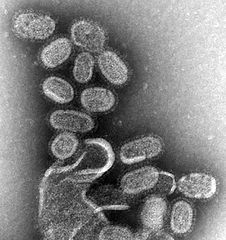
EM of influenza virus.jpgInfluenza, commonly known as "the flu", is an infectious disease of birds and mammals caused by RNA viruses of the family Orthomyxoviridae, theinfluenza viruses. The most common symptoms are chillsfeverrunny nosesore throatmuscle painsheadache (often severe), coughing, weakness/fatigue and general discomfort.Although it is often confused with other influenza-like illnesses, especially the common cold, influenza is a more severe disease caused by a different type of virus. Influenza may produce nausea and vomiting, particularly in children, but these symptoms are more common in the unrelated gastroenteritis, which is sometimes inaccurately referred to as "stomach flu" or "24-hour flu".Typically, influenza is transmitted through the air by coughs or sneezes, creating aerosols containing the virus. Influenza can also be transmitted by direct contact with bird droppings or nasal secretions, or through contact with contaminated surfaces. Airborne aerosols have been thought to cause most infections, although which means of transmission is most important is not absolutely clear.Influenza viruses can be inactivated by sunlight,disinfectants and detergents. As the virus can be inactivated by soap, frequent hand washing reduces th.Influenza, commonly referred to as the flu, is an infectious disease caused by RNAviruses of the family Orthomyxoviridae (the influenza viruses), that affects birds and mammals.
The most common symptoms of the disease are chills, fever, sore throat, muscle pains, severe headache, coughing, weakness/fatigue and general discomfort. Sore throat, fever and coughs are the most frequent symptoms.
In more serious cases, influenza causes pneumonia, which can be fatal, particularly for the young and the elderly. Although it is often confused with other influenza-like illnesses, especially the common cold, influenza is a more severe disease than the common cold and is caused by a different type of virus.
Influenza may produce nausea and vomiting, particularly in children,
Typically, influenza is transmitted through the air by coughs or sneezes, creating aerosols containing the virus. Influenza can also be transmitted by direct contact with bird droppings or nasal secretions, or through contact with contaminated surfaces.
Airborne aerosols have been thought to cause most infections, although which means of transmission is most important is not absolutely clear. As the virus can be inactivated by soap, frequent hand washing reduces the risk of infection.
Influenza spreads around the world in seasonal epidemics, resulting in the deaths of between and people every year, up to millions in some pandemic years.
On average 41,400 people died each year in the United States between 1979 and 2001 from influenza.
Three influenza pandemics occurred in the 20th century and killed tens of millions of people, with each of these pandemics being caused by the appearance of a new strain of the virus in humans.
Often, these new strains appear when an existing flu virus spreads to humans from other animal species, or when an existing human strain picks up new genes from a virusthat usually infects birds or pigs.


Yarsagumba is known as cordecypes sinensis According to botanical nomenclature .Cordyceps is a Chinese fungus used in Traditional Chinese Medicine (TCM) for “lung protection” and “reproductive invigoration” as well as to balance the fundamental “energy of life.” Cordyceps is also known as the Chinese caterpillar fungus because it is a parasitic organism that grows on a rare Tibetan caterpillar until the 
caterpillar dies and the mushroom sprouts from the caterpillar’s head. 
Owing to the herb's high efficacy and potency in curing various diseases, it is well known 
as an important nourishing tonic. However, as the source and the gathering of the herb is 
rare and difficult, so its supply often falls short of demand. 

DOSAGE OF CORDYCEPS SINENSIS:

For a healthy person who uses YARSAGUMBA as an aphrodisiac, life-giving, stimulant for sports etc. The recomended dose is: 0,3—0,7 g ( 1—2 pcs according to the size) daily, eat whole mushroom in original form, or overflow with boiling water (tea) and eat after 20 min., or powder it and drink with milk, for 3—4 days. After pausing for 3 days it is possible to repeat dosage. In the case of particular health problems, the dosages are often higher, but it is recomended to consultate this with your doctor.
In Asia YARSAGUMBA is cooked with many kind of dishes: chicken or duck soup, pork specialities, boiling it in ducks stomachs, or feeding the duck withCATERPILLAR FUNGUS and after 2—3 days preparing the duck and eating it. (This pre-fed duck usually has very tasty meat!) As a powder it is often consumed with drinking water, milk or tea.
The taste is pleasant, sweet, with a nutty-mushroom flavor. Any aversion to consuming caterpillars (although actually there is no more caterpillar, just its cover) is quickly overwhelmed by the benefit whichYARSAGUMBA provides. There is no possibility of overdose with CATERPILLAR FUNGUS, and, according to all available information, there are no known harmful or negative side effects, even for pregnant women.
MARKETING: 
A. Production Volume and Trade
In the remote districts, it is sold at NRs 3 to 5 per piece, and in India it is sold at about 
NRs 28,000 per Kg.  There are about 3,500 – 3,600 pieces per Kg of Yartshagumba. 
B. Current Market Channel
Collector -> Village trader -> Regional trader -> wholesaler -> exporter 
C. Current Processing
There is both neither processing nor any kind of value-additive works currently being 
done in Nepal except drying (sun drying) and grading (separation of products according 
to size).  For storage purpose, Yarsagumba should get a treatment immediately after 
collection.  This treatment does not require any sophistication but simply a fast drying 
process.  If there is no sun, the fungus is heated over an open fire for 5 to 7 minutes. 
D. Variability and Risk
If caught with Yarsagumba, the royalty rate is NRs. 500/fungus for judicial purpose 
(Forest Rules, 1995). 


Powered by Blogger.